
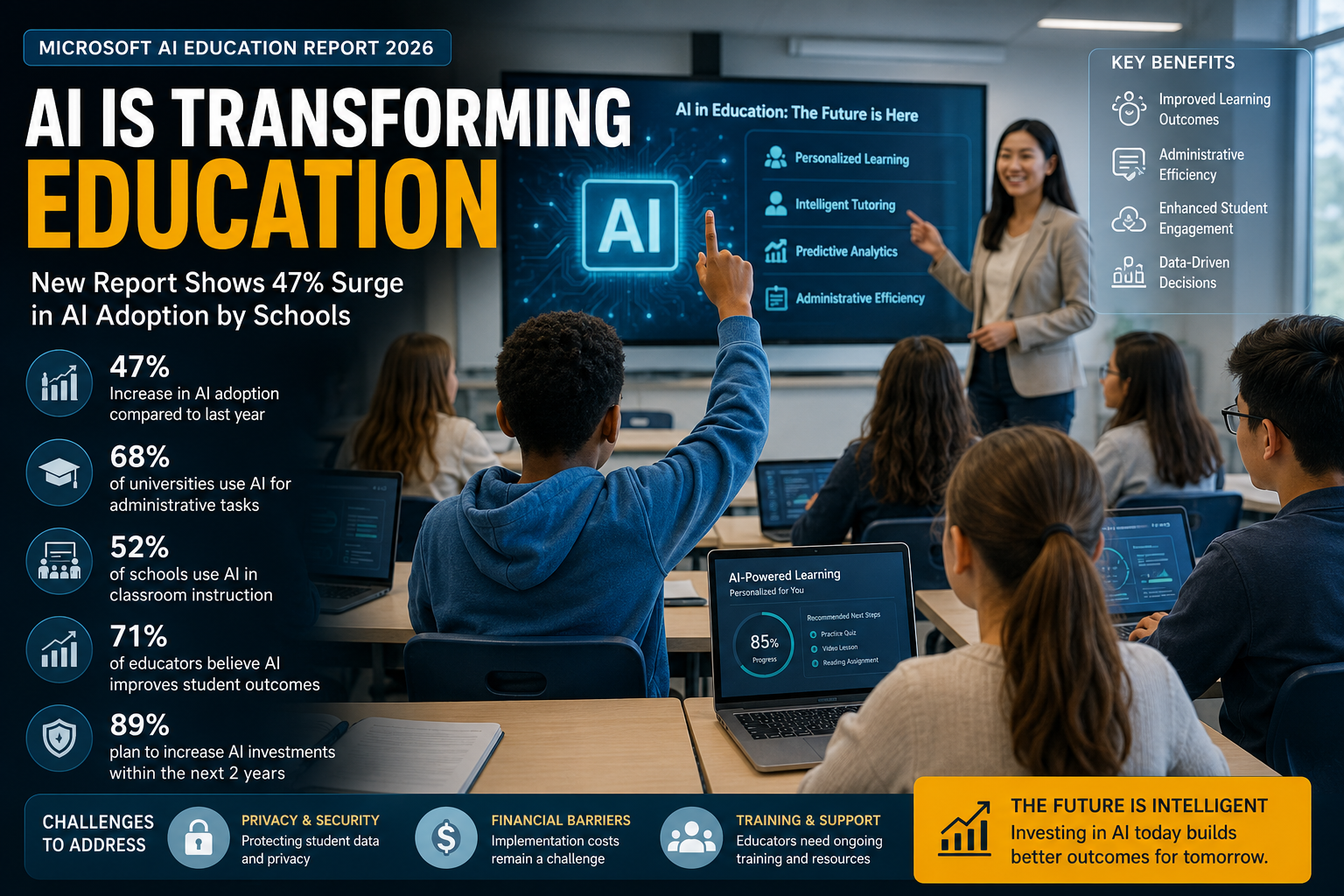
A new Microsoft AI education report has revealed startling trends across schools and universities worldwide. AI adoption in educA new Microsoft AI education report has revealed startling trends across schools and universities worldwide. Notably, AI adoption in education has accelerated dramatically this year. Additionally, institutions are integrating artificial intelligence tools into classrooms faster than ever before. The Microsoft AI education report provides critical insights into this shift. Furthermore, educational leaders are embracing AI to enhance learning outcomes and streamline operations.
What the Microsoft AI Education Report Reveals
Key Statistics and Data
The Microsoft AI education report documents a major turning point in 2026. Specifically, schools and universities have increased AI implementation by 47 percent compared to last year. Consequently, this growth represents the fastest adoption rate since AI tools became widely available to educators.
The report analyzed responses from over 2,000 educational institutions. Moreover, researchers surveyed administrators, teachers, and IT leaders across multiple countries. As a result, their findings show clear momentum toward AI integration in academic settings.
Why This Matters Now
Therefore, this surge signals a transformative moment for education globally. Indeed, the timing reflects growing confidence in AI reliability. Additionally, schools now see AI as essential infrastructure rather than experimental technology.
Why Schools Are Adopting AI Technology
Improved Learning Outcomes
Educators cite several key reasons for embracing AI tools. First and foremost, AI improves personalized learning experiences for students. Specifically, teachers use AI-powered systems to adapt lessons to individual student needs. As a result, each student receives customized instruction based on their progress and learning style.
Administrative Efficiency
Meanwhile, AI reduces administrative workload significantly. In fact, grading, attendance tracking, and scheduling become automated through intelligent systems. Therefore, staff members gain valuable time for meaningful work. Consequently, schools operate more efficiently with fewer manual processes.
Enhanced Student Engagement
Furthermore, institutions report improved student engagement when using AI. Importantly, interactive tools make learning more dynamic and responsive. Indeed, students receive immediate feedback on assignments and assessments. Thus, motivation and participation increase noticeably.
Key Findings from the Report
Adoption Rates by Institution Type
The Microsoft AI education report highlights several important statistics:
- 68 percent of universities now use AI for administrative tasks
- 52 percent of schools employ AI in classroom instruction
- 71 percent of educators believe AI improves student outcomes
- 45 percent cite budget constraints as the main adoption barrier
- 89 percent plan to increase AI investments within the next two years
Growth Trajectory
These figures demonstrate sustained interest in educational AI. Moreover, institutions recognize the competitive advantages AI provides. Therefore, investment in AI infrastructure continues to grow across the sector. Undoubtedly, this trend will accelerate through 2027.
How AI Is Transforming the Classroom
Student Support Systems
The Microsoft AI education report describes practical applications reshaping education daily. Particularly, teachers use AI chatbots to answer student questions outside class hours. Meanwhile, AI tutoring systems provide supplemental instruction to struggling learners. Additionally, predictive analytics identify at-risk students before problems escalate.
Administrative Applications
Administrative staff benefit equally from these technologies. Specifically, AI streamlines enrollment processes and optimizes resource allocation. Furthermore, campus security systems use AI for enhanced monitoring and safety protocols. Consequently, operations become more secure and efficient.
Learning Customization
Moreover, personalized learning pathways emerge through AI analysis. In particular, systems track individual progress and adjust difficulty levels automatically. Therefore, no student falls behind or becomes bored. Indeed, this customization transforms traditional one-size-fits-all education.
Challenges and Concerns
Privacy and Data Security
Despite positive trends, the Microsoft AI education report acknowledges significant obstacles. Notably, privacy concerns remain prominent among educators and parents. Specifically, data security issues require careful attention as institutions collect more student information. Therefore, strong safeguards become essential before full-scale implementation.
Financial and Resource Barriers
Additionally, many schools struggle with implementation costs. In particular, smaller institutions lack funding for comprehensive AI system deployment. Meanwhile, training teachers to use these tools effectively presents another challenge. Consequently, educators need ongoing professional development and support.
Employment Concerns
The report also notes concerns about job displacement. Specifically, some worry AI might reduce employment opportunities for support staff. Therefore, educational leaders must balance efficiency gains with workforce considerations. Indeed, this tension requires thoughtful resolution.
Looking Ahead: The Future of AI in Education
Growth Projections
The Microsoft AI education report projects continued growth through 2027 and beyond. Specifically, educational institutions expect AI adoption to become standard practice. Furthermore, classroom technology will increasingly rely on intelligent systems. Therefore, resistance to AI will gradually diminish.
Success Factors
However, success requires careful planning and investment. Notably, schools must prioritize data protection and privacy safeguards. Additionally, teachers need comprehensive training programs. Moreover, students should develop AI literacy alongside traditional skills. Thus, holistic preparation ensures effective implementation.
Recommendations for Educational Leaders
Strategic Planning
Start with clear goals before implementing AI systems. Specifically, identify specific problems AI can solve at your institution. Therefore, avoid adopting technology for its own sake. Instead, align AI initiatives with educational missions and objectives.
Staff Development
Next, invest in teacher training and ongoing support. Clearly, educators cannot leverage AI without proper preparation. Furthermore, establish mentorship programs pairing experienced users with newcomers. Therefore, knowledge spreads throughout your organization.
Data Protection
Importantly, establish strong data privacy policies. Specifically, protect student information while capturing benefits from AI tools. Therefore, conduct regular security audits and updates. Moreover, communicate transparently with parents about data practices.
Outcome Measurement
Finally, monitor outcomes carefully. Specifically, measure whether AI implementation actually improves learning and efficiency. Subsequently, adjust strategies based on results and feedback. Therefore, continuous improvement becomes standard practice.
The Bigger Picture
Educational Transformation
The Microsoft AI education report signals a fundamental shift in educational delivery. Notably, technology integration is no longer optional for competitive institutions. Therefore, schools embracing AI today position themselves as educational leaders. Indeed, early adopters gain significant advantages.
What Changes
This transformation extends beyond simple automation. Specifically, AI enables personalized education at scale. Consequently, teachers gain time to focus on mentoring and relationship building. Furthermore, students receive support tailored to their individual learning styles. Therefore, education becomes more human-centered, not less.
Implementation Reality
However, widespread AI adoption requires thoughtful implementation. Notably, quick fixes without planning create problems. Instead, sustainable change demands investment in people, processes, and technology. Therefore, patience and strategic vision prove essential.
Conclusion
The Microsoft AI education report documents a pivotal moment for schools and universities. Clearly, AI adoption continues accelerating across educational institutions globally. Moreover, benefits are evident: improved learning outcomes, reduced administrative burden, and enhanced student engagement.
Yet challenges remain for many schools. Specifically, cost, training, and privacy concerns require serious attention. Therefore, educational leaders must approach AI implementation strategically. Indeed, thoughtful planning separates successful implementations from failures.
Ultimately, the data shows this trend will continue. Specifically, institutions that embrace AI thoughtfully will thrive. Meanwhile, those that delay risk falling behind peers. Therefore, the future of education increasingly depends on intelligent technology integration.